
The Hair Care Insider
Health & Wellness Reporting
HEALTH & WELLNESS · MEN'S HAIR SCIENCE
Why Your Hair Is Really Thinning — And Why Most Treatments Make It Worse
New research reveals the real mechanism behind male hair loss. It's not genetics. It's not stress. It's a hormone your body produces every single day — and most treatments completely ignore it.
BY THE HAIR CARE INSIDER RESEARCH DESK · 9 MIN READ
It's Not Just Genetics
Most guys tell themselves the same story. "My dad was bald, so I'll be bald too." It feels like a done deal — like the whole thing was written down before you were even born, and there's nothing you can do but watch it happen. But that story is only half true, and the half that's missing is the part that actually matters.
Here's the way to think about it. Genetics load the gun. But a hormone called DHT is what pulls the trigger. You can carry all the "bald genes" in the world, and none of it goes off until that hormone starts doing its quiet work on your scalp.
DHT is short for dihydrotestosterone. It's a byproduct your body makes from testosterone every single day. On its own it isn't evil — but on your head, it does something sneaky. It attaches to your hair follicles and slowly shrinks them, cycle after cycle. Each time a hair grows back, it comes back a little thinner and a little shorter than before. Do that enough times and the follicle is still alive, but the hair it makes is so fine and so short you can barely see it.
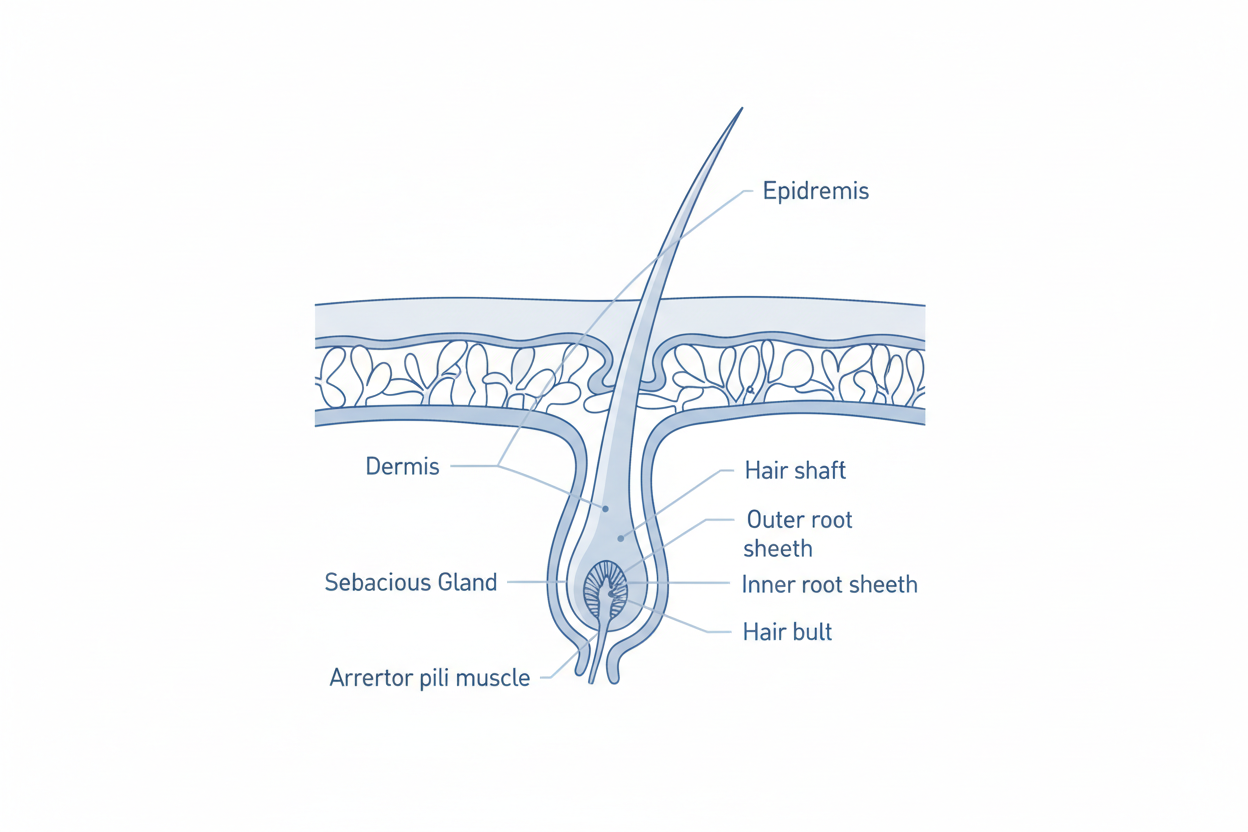
A hair follicle in its shrinking phase, viewed in cross-section.
The worst part is the timing. By the time you finally notice the thinning in the mirror — the light coming through on top, the hairline that isn't where it used to be — you've usually already lost around half of your density in that area. Half. Gone before you ever clocked it.
That's the whole trick of it. Hair loss isn't sudden. It's silent.
Why Most Treatments Fall Short
If you're reading this, chances are you've already tried something. Maybe a pill, maybe a foam, maybe a bottle you found online that promised the world. And maybe it did a little — for a while. But here's the thing nobody tells you: most treatments only ever solve part of the problem, and the part they miss is usually the part that matters most.
Prescription pills. Finasteride works from the inside, blocking DHT before it ever reaches your scalp — and on paper, that sounds like the whole answer. The problem is the side effects. They're real enough that a lot of men quietly quit within a few months, and if you've done any research at all, you already know exactly what they are.
Minoxidil. This one increases blood flow to the follicle, which can wake things up and push out some growth. But it does nothing about DHT — the actual thing shrinking your hair. So the moment you stop using it, everything you gained falls right back out. You're not treating the problem, you're renting a solution, and the rent never stops.
Hair loss shampoos. Think about how you actually use one. It sits on your scalp for maybe sixty seconds before you rinse it off in the shower. That's simply not enough contact time for any active ingredient to work its way down and actually penetrate the follicle. It goes on, it comes off, and most of the good stuff heads straight down the drain.
Serums and oils with droppers. These feel precise, but they aren't. You squeeze out a few drops, spread them around more or less at random, and watch half of it drip down your forehead before it ever settles. Most of the product never reaches the follicles that actually need it — it just sits on the surface, going nowhere.
The real problem was never a lack of products. It's a lack of precision.
What the Research Actually Shows
Back in 2015, a study published in the SKINmed Journal set out to answer a simple question — could a natural oil hold its own against the gold-standard treatment? So researchers took two groups of men and pitted rosemary oil head-to-head against Minoxidil, the same active ingredient in most drugstore regrowth products.
After six months, the results were hard to argue with. The rosemary oil group showed the same increase in hair count as the Minoxidil group — same growth, same measurable difference, from a plant oil instead of a lab chemical. And here's the part that really matters: no dependency, no side effects, and no shedding when the men stopped using it. Nobody had to keep renting their results.

Thermal imaging shows increased blood flow to treated follicles.
But before you go pour rosemary oil on your head and call it a day, there's a catch. Rosemary oil is great at what it does — it wakes up the follicle and gets things growing again. What it doesn't do is block DHT, the hormone actually causing your hair to thin in the first place. So on its own, it's only ever fighting half the battle, pushing growth while the real culprit keeps working against you in the background.
So what if you could do both at the same time?
Nine Ingredients, One Formula
That's exactly the question a small Canadian brand set out to answer. Instead of picking one active ingredient and hoping it did enough, they combined nine clinically studied ingredients into a single serum — each one targeting a different part of the hair loss cycle. Some block the hormone that's thinning your hair, some wake up follicles that have gone dormant, and some protect and feed what's already growing. Here's what's actually in it.
3% Rosemary Oil
Boosts blood circulation to the follicles and has been clinically shown to match Minoxidil for hair density. This is the natural growth engine of the whole formula.
Saw Palmetto
Blocks DHT naturally at the follicle level, and a 2025 randomized controlled trial confirmed its effectiveness. It's the ingredient most competitors simply don't have.
3% Redensyl
Targets hair follicle stem cells directly, reactivating follicles that have gone dormant so they start producing hair again.
2% Aminexil
Anchors the hair at the root by preventing collagen buildup around the follicle. In plain terms, it stops the shedding before it starts.
2% AnaGain
Derived from organic pea sprouts, it extends the active growth phase so each strand has more time to grow longer and thicker before it rests.
Tea Tree Oil
Antibacterial and antifungal, it clears out clogged follicles and calms scalp inflammation so everything else can do its job in a healthy environment.
Red Clover
Brings phytoestrogens to the table for hormonal balance right at the scalp level, keeping the whole environment steady.
Panthenol B5
Strengthens each hair strand and restores the scalp's moisture barrier, so hair grows in resilient instead of brittle.
Moringa
Delivers vitamins A, B and E along with zinc and iron directly to the follicle, feeding the roots the nutrients they need to keep producing.
Put it all together and the logic is simple — three of these ingredients block DHT, three reactivate dormant follicles, and three protect and nourish what's already there. That's the full cycle covered in one bottle, and no other product on the market combines all nine in a single formula.
Why Delivery Matters as Much as the Formula
Here's the part almost everyone gets wrong. You can build the best formula in the world — nine perfect ingredients, all clinically studied — and it still means nothing if it never actually reaches the follicle. That's the real problem. Most serums come in a dropper or a spray, and the moment you apply them, half the product runs down your forehead, gets soaked up by your hair, or evaporates before it ever gets where it needs to go.
So this formula was built around a precision roll-on applicator with a small metal rollerball tip. You place it directly on the thinning area and the ball rolls the serum exactly where the follicle needs it — no dripping, no mess, no waste. Instead of running down your face, the product stays right on the scalp, sinking into the follicle opening where it can actually do something.
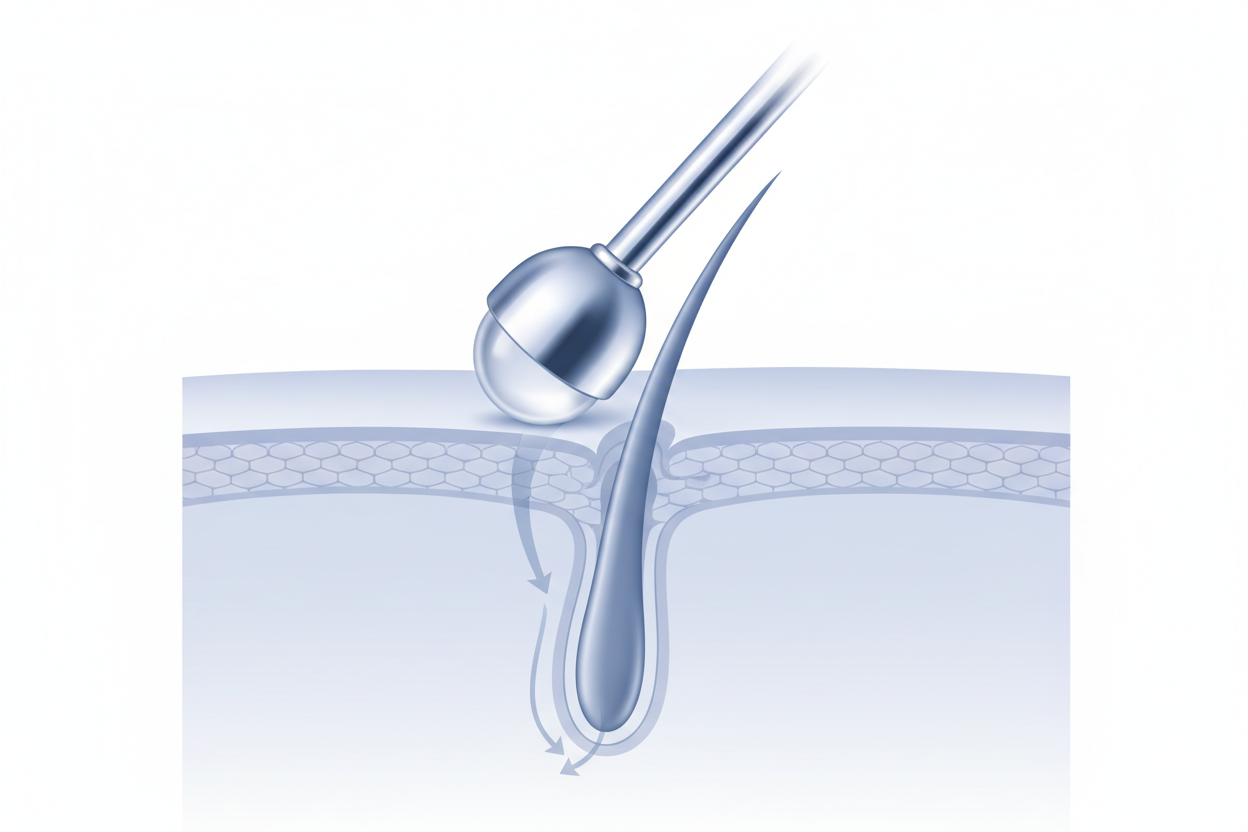
Precision delivery: serum reaches the follicle directly, without runoff.
And that's really the whole point. For years, almost all the innovation in this category has been about the formula — new actives, higher percentages, cleaner ingredient lists. Which is great. But nobody really stopped to think carefully about delivery — about how the serum actually gets from the bottle to the root — until now.
A Simple Daily Routine
The best part is how little this actually asks of you. Roll it on once in the morning, around 7AM, and once again at night, around 7PM — that's it. Each pass takes less than 60 seconds, so it slips into the routine you already have without you ever really thinking about it. No pills to remember, no prescriptions to chase down, and nothing your scalp becomes dependent on. Just a quick roll, morning and night, and you get on with your day.
Weeks 1–4
Reduced shedding is usually the first thing men notice.
Weeks 4–8
Hair starts to feel thicker to the touch.
Weeks 8–12
Visible filling in of thinning areas.