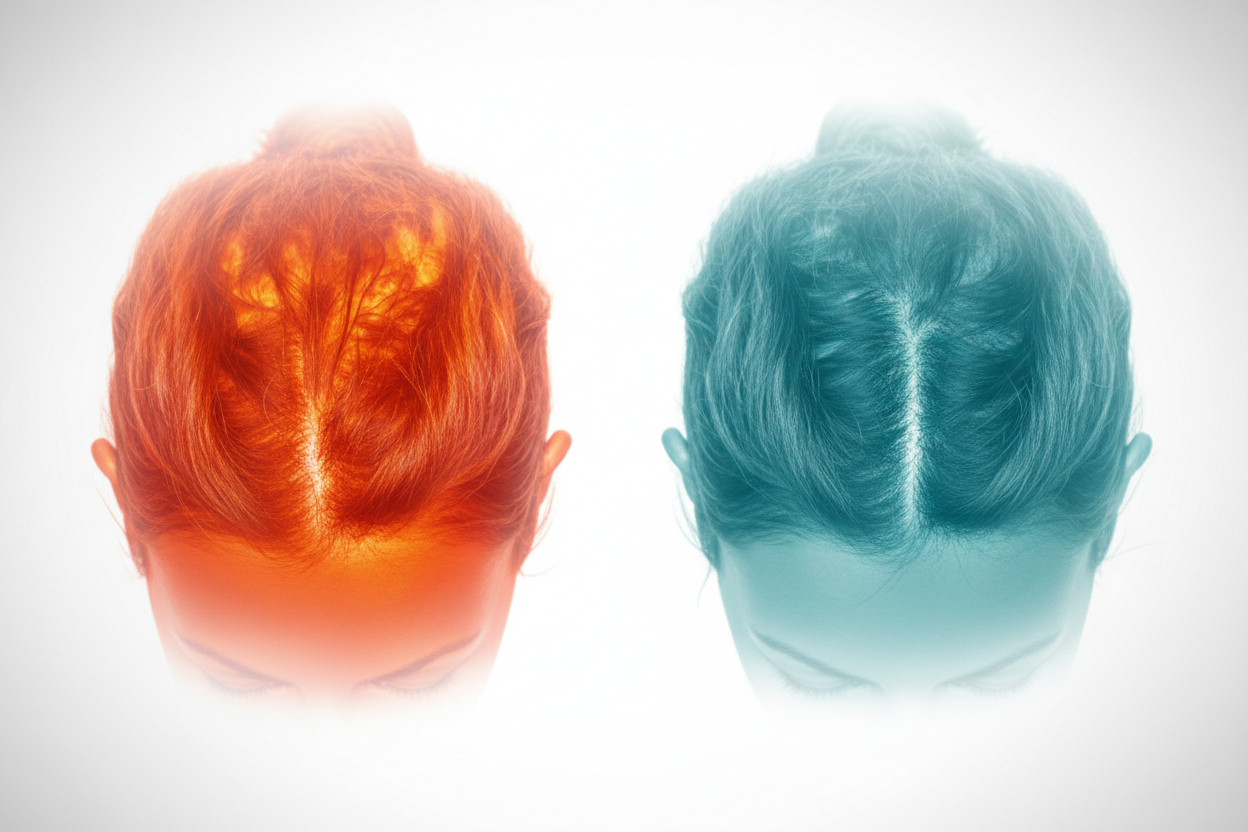
For most of your adult life, you had a bodyguard you never knew about. Through your twenties and thirties, your estrogen levels stayed high and steady, and estrogen does two quiet favors for hair. It keeps each hair in its active growing phase longer, which is why hair grown in those years was long, thick, and dense. And it shields your follicles from a hormone called DHT.
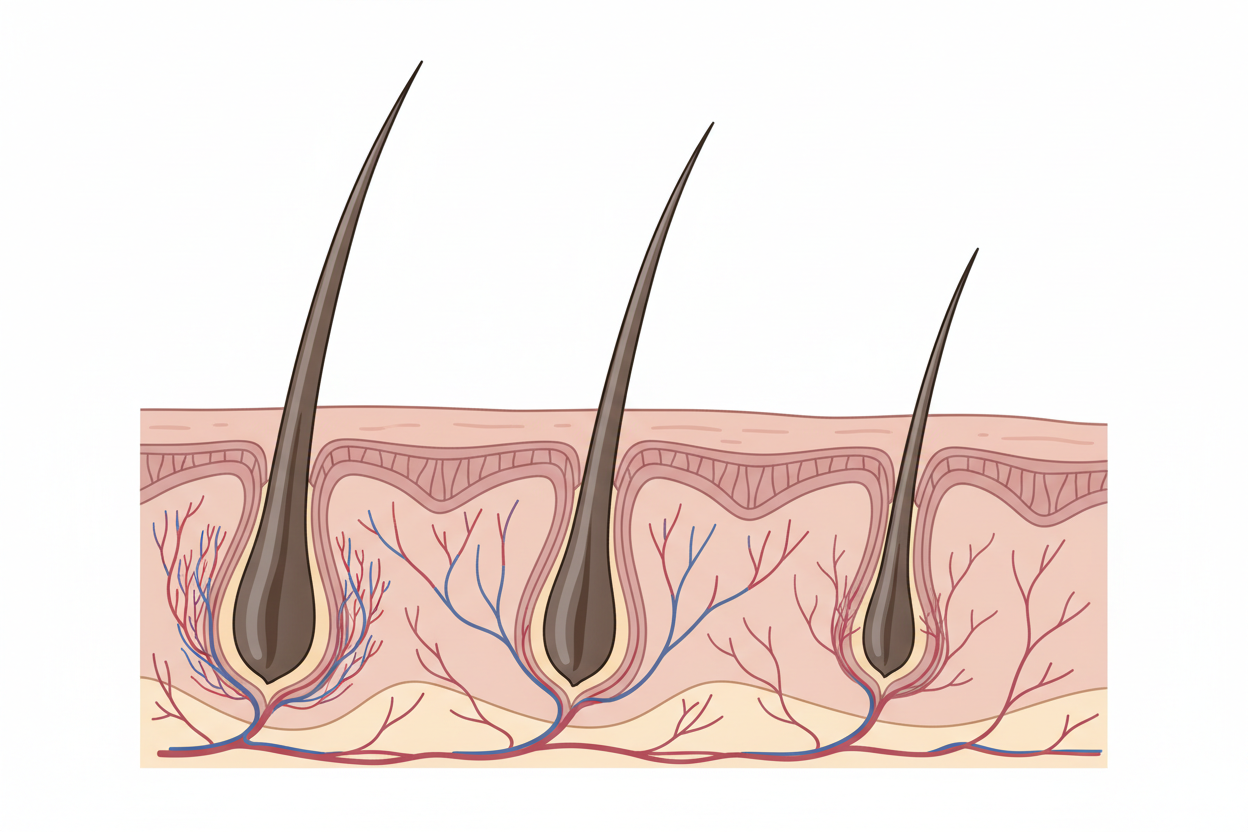
DHT — dihydrotestosterone — is made from testosterone, and every woman has some. On its own it isn't dangerous. But hair follicles on the top of your scalp are unusually sensitive to it. When DHT reaches those follicles and binds to them, it tells them to shrink. Doctors call this miniaturization. With estrogen in the picture at full strength, that message barely gets through.
Then, somewhere in your late thirties, estrogen begins to slide. Through perimenopause it drops unevenly, month to month, and by the time you reach menopause it has fallen to a small fraction of what it once was. Your DHT levels haven't necessarily gone up — but the protection has gone down. And that changes everything at the follicle.
Now DHT reaches your follicles unchecked. It binds. The follicle shrinks a little. It cycles, sheds that hair, and grows a replacement — but from a smaller follicle, so the new hair comes in slightly finer and slightly shorter. That hair sheds, and the next one is finer still. Cycle after cycle, year after year, each hair is produced a little weaker than the last, and the growing phase gets shorter while the resting phase gets longer. Eventually some follicles shrink so far that the hair they make is barely visible — soft, colorless, and short, like the fuzz on your cheek. The follicle is still alive. It's just no longer producing hair you can see.
Multiply that by thousands of follicles across the top of your scalp and you get exactly what you're seeing in the mirror. The part widens because the hairs beside it got finer, not because they disappeared. The ponytail shrinks because you have the same number of hairs, each with less body. Volume goes flat because fine hair can't hold shape the way thick hair does.
This is the part worth sitting with: what you're experiencing isn't a vague, unstoppable consequence of getting older. It's one specific hormonal mechanism with one specific effect — and a mechanism can be interrupted.